Showing posts with label russians. Show all posts

Wednesday, May 6, 2015

100 Years Later

We were standing between two countries, yet not really in no man’s land. On one side were the mountainous Slovak lands, and on the other were the low river-plains of Poland. We had just exited the undergrowth of a Beskid Niski forest onto a paved road, and were now taking a mental breather, looking at the dual existence of the countries signs, before we would reenter the foliage and continue on the other side of the road.  

The Beskid Niski Mountains are a low lying sub-range of the greater Beskid Mountains that stretch from the corner of the Czech Republic, along the Polish-Slovakian border, and into Ukraine. This greater Beskid range then evolves into the much greater Carpathians which inhabit a large chunk of central and eastern Europe. It’s the mountain range where, because of Bram Stoker, bloodcurdling screams could be heard from Dracula’s castle while he bit the necks of his innocent victims. Luckily we weren’t anywhere near Transylvania.

Our hike was taking us through Gorlice county, where, 100 years ago from that day, a great offensive was being produced on the Eastern Front of World War 1. The group that organized this war-themed hike was named Studenckie Koło Przewodników Beskidzkich or SKPB.

As a group of about 25 of us trampled through the unseen path, following our well-trained guides, I looked at the backpack in front of me, and it started to transform into a ragged rucksack being carried by a Hungarian soldier, with clanking metal pots hanging off of it and a bayoneted rifle being held, poking out languidly towards the ground on the left side of the soldier, and our guides morphed into the commanders dragging us to the battlefields through the uncharted thick forests, where we would most likely fall victim to another bayonet and breath our last breath.

100 years ago the Gorlice-Tarnów offensive was taking place exactly in these mountains. This great offensive came after depressing futile attempts by the Austro-Hungarians to push the Russians back towards Ukraine. The commanders of the Austro-Hungarian armies had needlessly thrown many young soldiers into extreme mountain climates during the height of winter with little thought, causing many helpless and painful deaths. But, as winter dissipated, and conditions became easier to deal with, the Germans joined the Austro-Hungarians on the Eastern Front, and on May 2nd, 1915, began pushing the Russians back through Gorlice county.

On May 2nd, 2015, our group stopped in front of two mass graves hidden behind some trees. They were quadrilateral stone structures with bulky half-meter orthodox crosses, symbolizing that they were Russian soldiers. There were two stone plaques commemorating them, but it read in German, “Fallen in the field of honor, 150 Russian soldiers.” Lying beneath us were almost 300 Russian skeletons (the other plaque stated 130 Russian soldiers), but above ground the stone structure had been built by the Austro-Hungarians. At every cemetery we stopped at this would be the case. Most of them were mixed with Austrian, Polish, Hungarian, Ukrainian, Slovakian, German, and Russian soldiers, but all them were built by the Austro-Hungarians, and this concept of indiscriminately honoring soldiers during war, regardless of if they were the enemy or not, was beautifully enchanting.

The cemetaries in the region we were hiking had all been designed by a Slovak architect named Dušan Jurkovič. In designing them he took inspiration from the folk art of the surrounding Łemko people, who were the majority of the inhabitants of this area in 1915. Construction of these cemeteries began during the offensive, and most of them finally finished in 1918. The multi-ethnic Austro-Hungarian Empire that produced them no longer existed. For the next three quarters of a century the Łemkos were relocated under communist Poland, so the area became depopulated, and the cemeteries fell into dilapidation. In the late 80s old cemeteries began to be rediscovered in forests that had grown over them, and throughout the 90s restoration projects took place that brought their existences back to reputable and honorable standards. Now they exist as hauntingly contemplative monuments.

We started in Grab, which sat isolated on a soft grassy hillside. There was a wooden structure built in the style of an old Slavic pagan temple. There was something eerie and mystifying about the shape, as though it was a long lost memory of the past. The headstones were wooden crosses, and here there was a mix of Russian and Austro-Hungarian soldiers. Next were the Russian mass graves at Ożenna, and then through the thick beech forests towards the former village of Czarne. This valley had once been populated by Łemko families, and even one gypsy family, but during communist times after the Second World War the population was moved to Soviet Ukraine and North-West Poland, and now there is only small clues that an entire community once lived there. We moved north towards Krzywa, and after a cold night, Kasia and I decided to split from the group, and head to the valley over, where we were in touch with a group from Warsaw that owned an old Łemko cottage in the village of Nowica.


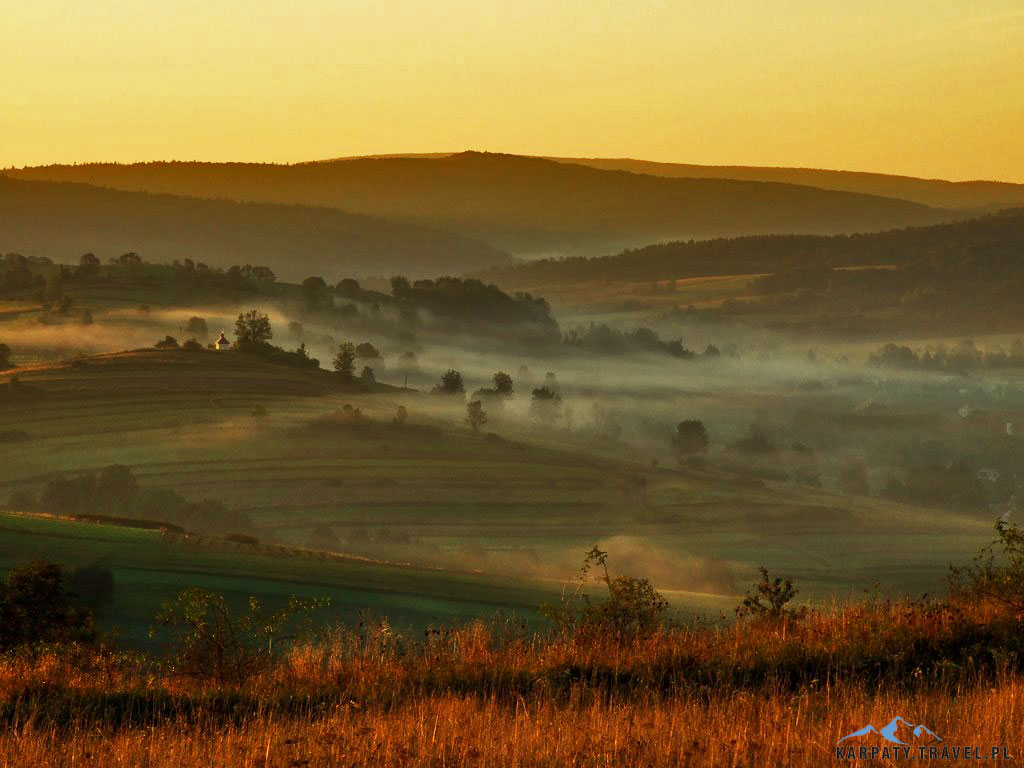
On the road to Nowica, before hitting the Magura Małastowska pass, we were able to spot a little salamander that was famous in this region. It’s black and yellow and named the fire salamander. They are slow moving, and very poor at hiding, and we found one with its head buried in a crack in an old stump every few meters. The path we were on was incredibly scenic and the mist caused by the weather made our way mystical and imaginative. At the pass we reached the last cemetery that we would see on this trip. Between the spruce and silver firs the headstones of Poles, Ukrainians, Hungarians and Austrians protruded from the ground. Here there was even one Jewish headstone, also carved from wood; the only one we saw at any of the cemeteries. We took a moment to think about the consequences of this brutal opening to the 20th century, and how these cemeteries have changed this landscape forever, and then we moved on towards Nowica. On the paved road we climbed up over the hill and as we were climbing we noticed a dead salamander on the road, squished by a car. A few meters later another one laid crushed with its guts exposed, and then another one and another one. Kasia began to shake, and she grabbed my arm and closed her eyes. As we passed another dead salamander I was reminded of the needless deaths of hundreds of thousands of young men who were not prepared to face the modern environment that was developing quickly before them. 


WW1 Cemetery in Southern Poland

Tuesday, January 27, 2015

70th Anniversary of the Liberation of Auschwitz

Today is the 70th anniversary of the liberation of Auschwitz-Birkenau. A few months ago I took the trip to the grounds of the former concentration and extermination camp. I found there the ruins of something far more menacing than I could have ever imagined. Beyond the atrocities of ISIS, beyond the barbaric murdering by Boko Haram, this was something inconceivable to anybody with a conscience and a desire to see humans of all cultural, religious, and ethnic backgrounds work together. It was a precisely planned mass extermination. Witnessing the machination of murder is truly the most harrowing thing I have ever experienced.
To put it plainly Birkenau (Auschwitz II) was designated as an extermination camp in 1942. There was a period of 2 months in 1944 where the gas chambers were used to kill 440,000 Hungarian Jews. They were ushered into the underground “showers” by classical music, told to undress, and then killed by the “showers” they were taking. This wasn’t limited to the Jews, as Hitler’s ideology was planned and extended to the Romanies and the Slavic races. At the end of it all at least 1.1 million people died at this complex of camps.
When the Red Army arrived on this day in 1945 they found emaciated survivors with terror in their eyes. Things would never be the same; no flower would ever smell as sweet. At the bottom there is a link to portraits of some of the miraculous survivors of Auschwitz-Birkenau, and it’s a good idea to take a moment, step back, and reflect on how such an ideology can manifest itself in the fabric of our lives. How can we as a species arrive to this barbaric moment? What questions do we need to ask in order to ensure that something like this will never  happen again? RIP to all the victims of systemized mass murder all over the world.

Friday, December 19, 2014

Poland and Mushrooms pt 1

I was standing in the middle of my kitchen, five stories up from Kaukaska Street in the monotonous Stegny neighborhood of Warsaw. I opened up the jar and held it up to my eye, examining the gooey maślaki mushrooms inside. A sour earthy smell came out and invigorated my senses with its pungent punch. I stuck my spoon inside and slid the slimy morsels out one by one into a small glass. Each one dripped out, splashed onto the enameled glass, and then sat there entombed in the transparent slime. I looked closely again at the alien looking creatures that had alternating smooth brown and porous cream-colored surfaces. The longer I looked, the more my fascination grew. But they were there for me to eat, and not to admire, and soon they exited from there interim resting place and into my mouth, and finally into my gut, where maybe they would sprout again.

100 kilometers north of Warsaw, on the cusp of autumn, I found myself in a small village near a town called Pułtusk. Here I was going to do something very Polish, very Slavic for that matter, in nature with my companion and life partner, Kasia. We were walking along the river Narew, a river that flows into the Wisła, which in turn then flows through the home of Kopernik’s Toruń, and out the mouth of Günter Grass’ Gdańsk into the Baltic Sea. We were on our way to pick some mushrooms, specifically kurki. Soon we broke off from the river and headed towards the wooded flatland. The idea was that later we would fry these mushrooms and eat them alone with spices, or mix them with scrambled eggs, and in my impressionable eyes this was a truly Slavic meal.  

While on this adventure, I remembered a scene that never left me from a Russian film named The Cuckoo. Two soldiers, a Finn and a Russian, have been betrayed by their countries; one left to die, and the other being taken to his trial. When things go wrong they’re both saved by an endearing Sami woman in the wilderness of northern Finland. The problem is that all three of them speak completely different languages, and so in communication there is no common understanding. This especially isn’t good when you're staring into the eyes of the enemy you’ve been fighting for the past 3 years. Things are tense, but they manage not to kill each other, mostly due to the pacifism of the Finn.

The scene I was thinking about happens when they're all doing different things, and you see the Russian picking something in the woods. He comes back home with a bucket full of gigantic dirt-encrusted mushrooms.

When the Sami woman sees him she says,

 “Don’t eat mushrooms or you’ll go loony.”

He responds,

“Don’t worry. I’ll cook them. The sergeant in my battalion cooked them wonderfully!”

Later he runs up to her with a boiling pot in his hand.

“Ma’am I need salt. Salt. Where is it?”

“I’m not mad enough to eat mushrooms” She waves her hand in a suggestion to go throw them out.

He thinks she’s pointing to the direction of the salt,

“In the house,” he says. “Ok I’ll go get it.”

Later they are speaking together.

“The mushrooms will be ready soon. We can eat. But we need some salt.”

“Yes,” she looks at him warily. “Mushrooms are bad. They can be poisonous.”

The next day he wakes up to find her standing over him. She looks worried and says,

“Do you feel bad? It must be the mushrooms. I’ll feed you some infusion and flush it out of you.”

He is completely expressionless and looks fine. She brings him some infusion soup that acts as a laxative, and he politely accepts her offer, thinking it’s just plain soup. Soon after he is ejecting everything from his rear end, and cursing the Sami woman to hell. The Finn walks outside, watches this spectacle and says,

“That’s what happens when you eat too many mushrooms.”

Despite its humor, this can be seen as a good example for understanding the relationship that Slavs have to their mushrooms. Through their utter lack of communication we find that what stands out in the Russian's mind is his mushroom culture, and what stands out in the others is their traditional misconceptions. 

I thought about this scene in Poland, far away (but not too far) from its Slavic cousin Russia. Would our fate be similar to that of the Russian? No, we had a common language and therefore there would be no misunderstanding. I asked Kasia cautiously,

“Do you know which ones are poisonous?”  

Her curt sardonic answer came reassuringly, “Of course!”


We circled the forest and scoured the soil, spying for the effervescent yellow prince’s crowns, but after an hour of not finding a sign of existence we went back home empty-handed. Apparently the weather had been too dry lately. All was not lost though, because as soon as we arrived at the cabin we were greeted by a whole clan of bulbous opieńki waiting patiently on a cut tree by the fence that wrapped around the corner of the house. Unfortunately though these wouldn’t be fried, and instead they would be pickled and kept in a jar, like the alien maślaki that sprouted up into their second life in my stomach.


Read part two here