Showing posts with label warsaw. Show all posts

Monday, March 9, 2015

Exploring Warsaw's New Metro Line

I set out to see the newly opened second metro line going east-west across Warsaw. The end of the line on the west side was only a six minute bus ride from my apartment in Wola, and began on Plac Daszyńskiego. The new line opened to the public on March 8th after a long delay. Originally said to be opened at the onset of the December holidays, mysterious reasons kept pushing the opening back. Recently though there was a stronger push to get it up and running, because one of the bridges crossing the Wisła caught fire, diverting and clogging a lot of central traffic. At the time of this incident I was staying in Wesoła in the far east of the city, and was unaffected by this sudden change. I took the suburban train which brought me straight to the center over a different bridge, but a friend of mine living much closer in Saska Kępa, one bus stop away from the bridge, said that after the bridge caught fire her commute skyrocketed from 30 minutes to two hours, because she had to circumvent the old route during high traffic. Initially officials were horrifyingly saying that the bridge wouldn't be reopened for a few years, maybe in 2017 or 2018, but more recently the Warsaw municipality has said that they hope to reopen it by fall of this year. That's a welcome relief for a lot of residents from the districts surrounding Łazienkowski Bridge.

With this backdrop the second metro line was to be hurriedly opened to ease the stress in the pressurizing center. The bus dropped me off at Plac Daszyńskiego and I peered around. From here I could see the skyscrapers of the city center. The ones that stood out were the imposing Złota 44 apartment complex, and Stalin's gift to Warsaw, the Palace of Culture and Science. Towering nearby was the Warsaw Spire currently under construction and revealing its skeletal insides. In order to soften this eyesore the tower is adorned with neon lights that spell out "Kocham Warszawę" (I love Warsaw). A few meters away was the entrance to the metro line, a strong red glass frame in the shape of an "M." I walked towards it and entered the first station.

The new metro line has a color theme, and at this first station I tried to think of the possible decisions for each color. Plac Daszyńskiego was red, but nothing was jumping to mind what that might symbolize. I already knew from pictures that Nowy Świat-Uniwersytet was purple, and I felt that was a good choice for a university stop, because purple was inherently a creative color, but the red remained a mystery. Later I realized that Plac Daszyńskiego was the stop for the Warsaw Uprising museum, and that the red could possibly be connected to this as a patriotic symbol, or even a color of the blood spilled by Warsaw's most praised heroes.

Waiting for the train to come I noted the cleanliness of the station, and the 90's pop-art style that reminded me a little of Spike Lee's "Do the Right Thing." I also got a vague impression that I was standing in a contemporary art museum, and that next I would be looking at a Keith Haring exhibit. There was no time of arrival and I kept peeking up the tracks looking for the lights of the next train. Suddenly all the lights of the station flickered then went off for a brief moment, then back on, then off again. This happened five times, and a few people laughed, amused by the apparent ineptitude. The train finally arrived, and everyone boarded. I wondered if there would be any more shortcomings at the other stations.

...

Next was Rondo ONZ, the business center of Warsaw. The station is a calming and slick white, and I think the real connection with the color is the chic looking entrances around the roundabout. The colors here have a connection to modernity, technology, capitalism's love of glass, and the sleek and minimalist tastes of the nouveau riche. The entrances are airy and give off a sense of speed, and they really complement the business buildings surrounding them. Before this area was a little bit tedious to get to, like most of the stops on the new line, but now it's impressively easy, and it's not hard to imagine that this will have a profound effect on the businesses that operate along the line.

I went down again and took the train to the next stop, Świętokrzyska, which means Holy Cross in Polish. The station is yellow with hues of orange, and it's the station where you can switch to the first metro line, "conveniently," according to the recorded English voice with a slight Polish accent that played on the train before arriving to the station. The change was definitely convenient, and this new found convenience made me giddy. Although, the first line looks like a washed-up relic compared to the new line, and going through the lackluster purple and yellow frames into the old line is somewhat of a buzzkill.

I stepped outside for a look around, and immediately felt pity for the ugly first line. The entrance ways are grossly unattractive and have the look of an abandoned project. From afar they look more like entrances to gritty underground bazaars you could find in Central Asia or the Caucasus (Station Square in Tbilisi comes to mind). Compared to the thick and jagged highlighter-yellow "Ms", these ghost-white and faded-blue ancient arcs looked unfortunate and out of place. Luckily, I only found two of them at this intersecting station, while there were at least four new entrances.

I descended back inside the pristine new line and headed towards the station I had seen most in pictures, the university stop. I got off and found that the purple was not overwhelming, and thought that this was evidence of good planning. Nowy Świat-Uniwersytet, is also a portal to Warsaw's past, being situated at one of the most historic streets in the city. It wasn't overly difficult to get to before, but now the psychological effect that exiting the metro into this beautiful area has is lovely. After being destroyed in 1944, Warsaw had to build itself from scratch. The planners wanted to retain some of its original identity, but for the most part the city on the west bank of the Wisła lacked an old European look, that is until you reach Nowy Świat, where they worked meticulously to recreate its 19th century charm (although I would have loved to see it restored to its early 20th century art nouveau style). Suddenly you're among the neoclassical and baroque style architecture you find all across Europe, and exiting the confident purple frames onto the street, you get a real sense that you're really in Europe. Standing on the corner of Nowy Świat and Świętokrzyska streets, I felt a seismic shift in Warsaw. Suddenly the focus was taken away from its old communist center, and brought to balance between its contemporary progress and its proud historic past.

The next station was the Centrum Nauki Kopernik (Copernicus Science Center). As I exited the train I noticed a slight difference in style. The ceiling had changed from perforated plastic to solid sky blue. They were still doing some maintenance on the escalator. There was an old woman who couldn't speak, but wanted her picture taken. She made a beeping noise, much like beaker from sesame street, to people who passed by, and showed them at what angle she wanted the picture taken, pointing wildly and beeping at the same time. After she stopped two or three people she decided to leave, and I could hear her beeping all the way up the working escalator. I followed her and was drenched in light. The station kind of reminded me of the Pacific Science Center in Seattle. Parts of the escalator were exposed and you could examine its insides, and the sky-blue atmosphere gave the sensation of the altruism of science. Its situated near not only the Copernicus Science Center, but also five minutes by walking to one of the nicest academic institutions in the city, the BUW, or Warsaw University Library.

Two of the entrances don't have the thick glass "Ms" overhead, and I felt this a nice thought, in order to keep the feeling of openness at the station. I believe it's also probably because one of the exits brings you right to the bank of the Wisła, and a big glass structure would look out of place and ugly next to the slow moving grey calm of the river. I was ecstatic about this location, and started pondering my future excursions to the riverside.

At this point I sat down in the station and thought about the 930 meter long passage underneath the Wisła. Just above me would be the slow moving water of Poland's beating heart. Just two days before only the handful of construction workers had been able to pass underneath the historic river. Now for the first time in history everyone who bought a ticket would be able to do it.

We reached the other side of the river and exited into the largest of the seven stations. Stadion Narodowy was spacious and grass-field green. Its open space and tall ceilings were a welcome sight after the cramped enclosing space of the rest of the underground. The large pillars between the platforms are curious blossoms of concrete, and across the tracks you can see the preparation for additional metro lines still in their rudimentary stages. The exit emerged onto a desolate looking spot just on the other side of the train tracks that separate it from the main parking lot for the stadium. I thought that maybe it wasn't a good stop to get off if you feel like getting a bite to eat, but on the contrary I realized that just around the corner began one of the main roads in Praga Północ, Targowa street. Two minutes of walking and you could find almost anything you were looking for, be it a cafe or some kebab, a clothes store or some furniture.

I descended back into the green cavern, and boarded the train to the last stop on the line. The Polish accented English speaker made it clear that this was the terminus, and that everybody should leave the train. Dworzec Wileński station drops you off in the heart of Praga Północ, and next to one of my favorite buildings in Warsaw, the Polish Orthodox Cathedral of St. Mary Magdalene. It's a building that shows the beauty of Russian religious architecture, and you can admire it without having to go to Russia.

Praga is a different city in itself, historically somewhat disconnected from the more traditional center. It was the least destroyed part of the city during the war and it has an authenticity about it that makes it quite endearing. One of the best features about the district are little icons that populate many of the courtyards, many festooned with bright flowers. Finished with the line, I decided to take the rest of the day walking around the district, and I found at least five beautiful courtyard icons. Nearby was the famous Ząbkowska street, the heart of Praga Północ. A street that used to be a synonym for crime and destitution, but is now one of the trendiest places in Warsaw. It's said by many that hipster artist have been flocking to this area for the past few years, especially since its cleanup and renovation at the turn of the millennium.

On this street I found a cafe and bistro named Galeria Sztuki (Gallery of Art). I ate an excellent turkey dish with boiled potatoes, an artisan salad, and cream of leek soup for 18 PLN. As I was drinking my coffee in the rustic feeling cafe I looked out the window and marveled at how simple it was for me to get to this point. The seven stations take about 12 minutes to traverse, add another six minutes for a bus ride from my apartment, and I could be at a spot, that traditionally took me 40 plus minutes to get to, in less than 20 minutes. Warsaw is opening up now, and the possibilities are multiplying. This is an exciting time to be a Varsovian.


Saturday, January 31, 2015

Quotes about Poland #1 "A Country in the Moon."

It's a snowy day in Warsaw, the first of the winter where the snow hasn't melted by nightfall. I look outside towards the grey blackening sky, and hope that tomorrow there will be more snow. Warsaw is an unromantic place in the winter without it. I want to take this opportunity to look at a few quotes from a memoir I recently read about Poland. Michael Moran's experience spans from 1992 to 2008, when he published the book. He has many astute, intuitive, and piercing things to say about the country that he fell in love with and where he eventually dropped anchor. This will be the first of a few parts, or maybe even a running series titled "Quotes about Poland." 

I turn around and see now that the light from the sun has disappeared, and what remains are the illuminations from the windows of the monotonous blocks of flats, suspended in mid-air like apparitions of portals that lead to separate unique worlds. They pattern the horizon like a vertical chessboard, and provide a fleeting sense of intimacy to the residential surroundings. Back to my bright monolithic, yet labyrinthine computer screen, I feel it's time to look at some quotes about Poland from the book A Country in the Moon: Travels in Search of the Heart of Poland by Michael Moran.

Moran-“Warsaw brings into question the nature of memory itself and the responsibility one owes to a fading past. The continued existence of this city is a miracle and it would churlish to criticize its mostly unlovely appearance. Between the wars Warsaw possessed one of the richest cultural and artistic scenes in Europe. The writers Isaac Bashevis Singer and Czesław Miłosz, both Nobel Prize winners, worked in the capital. The concert pianists Artur Rubinstein and Ignacy Jan Paderewski performed in an atmosphere of champagne and cultivated outrageousness. The most daring cabarets such as The Sphinx, the Black Cat and the notorious Qui Pro Puo flourished in Waraw to rival the most risqué cabaret in Berlin. Some considered it ‘the Paris of the north.’”

Sealth-It’s hard to say the same about today, although Warsaw continues to be a center for affluent growth. There’s a perennial feeling that something is developing along the old lines of a cultural hub in Central Europe, but it takes decades to wash away the stench and stagnation of communism. It’s easy to imagine that the citizens of this phoenix have a desire to slowly return it to its former glory, but more probable is the desire to transform it into something unprecedented and unique. This is one of the charms about living in 21st century Warsaw.

Moran-“In Poland communism led to a complete erosion of ethics in almost all transactions of life outside the family and the few other ‘closed’ social groups.…The communist mentality of absolute distrust and veiled intentions will be difficult to eradicate….The cultivation of Byzantine defensive strategies was an imperative in Polish society if you were not a member of the Party….This is hardly surprising considering the severe penalties imposed by successions of totalitarian invaders if one ‘said the wrong thing.’ Most of my correspondences during the course of the breakdown of the project remained unanswered, telephone calls were not returned whether in English or Polish….Communism seems to have created a permanent climate of fear.”

Sealth-Here he is speaking about Poland in 1992, just 3 years after the fall of communism and the lifting of the Iron Curtain. To tell the truth there are still small traces of these practices. I was in touch with a potential employer who was half way through the visa process, when they changed their mind unexpectedly, and without an explanation. Eventually all communication ceased to exist, and they stopped answering my phone calls. There is disconnection in communication in the business world, and it makes even simple things like renting an apartment a testing experience. There is a major difference between generations though, and the farther Poland moves away from communism, the more open, communicative, collaborative, and ethical the country is becoming.

Moran-“The present generation of young people raised in freedom are largely unaffected by the communist upbringing of their parents. They could be on a different planet to their elders, yet many could profitably relearn the charm, graciousness and sensibility that Poles were famous for throughout Europe before the Second World War. A completely different breed of young Poles is emerging who are excellent at languages, highly skilled professionally, ambitious and hard-working, who have a more cosmopolitan and internationalist outlook.”


Sealth-Move over Germany, here come the Poles. They have energy, and youthful ambition. They are growing into an elite European workforce, and maturing into their proud cultural identities. I love the young generation in Poland, because they fight like they have something to prove, and they fight well. They have an arcane and difficult language that they can be proud of, and an emotional historical past. Their intelligentsia can be credited in some of the most profound ways for music, literature, poetry, anthropology, astronomy, chemistry, and military knowledge. It’s not far off to imagine that western European women will be swooned by the intelligence and charisma of a charming young Pole, as British women so collectively were by the famous Polish pilots during World War II.

Monday, December 29, 2014

Poland and Mushrooms pt 2

Kazimierz was the first person that I met in Poland. After one month of hitchhiking from Tbilisi, Kasia and I crossed the border between Slovakia and Poland on a scarcely traveled road in the Lower Beskid Mountains, and eventually arrived in front of an old Łemko wood cottage in the village of Nowica. We knocked on the big wooden door, and it slowly swung open to an almost identical copy of Lech Wałęsa. The frumpy white-haired man invited us in.

We later learned that Kazimierz was an eccentric liar. We sat near the fire and he told us stories about the origins of the Łemkos, or the rarity of soapstone, or the idea and uniqueness of Greek Catholicism. He said everything in Polish, and it had to be reluctantly translated by Kasia. He reveled in his stories, and had a charming gleam in his eyes. The truth was that he was there as an craftsman who was working on the stone path of the cabin, and in his spare time carved figures out of rocks that he had gathered. He showed us one of the rocks outside, the size of a large watermelon, which he planned to carve into the Virgin Mary and baby Jesus. He was a solitary figure at this cabin, a true recluse that was a tad misanthropic, but immensely enjoyed company if it was given. For us though he babbled all the time and there was no way of escaping it. I sat across the giant wooden slab that was the table and glanced back and forth between the fire and the Lech Wałęsa look alike, while Kasia sat next to me and listened intently with good intentions, translating when Kazimierz and she decided it was necessary. I was slowly being indoctrinated into the eccentricity that is Poland.

We followed him to a stream nearby where he showed us a couple of fossilized rocks. We became intrigued by the environment around us and started picking up every rock, examining it, and waiting for an explanation from our misanthropic expert. After a longwinded explanation about how soapstone becomes unbreakable when it completely dries (it doesn’t) we all headed back to the cabin. Through the woods Kazimierz spotted something a few meters away and became livid. Grunting “ohs” and “ahs” and gesticulating towards the object. Kasia and I could see it too, something creamy white and lying in the dirt. I didn’t quite understand, but Kasia told me it was a mushroom. He ran over to it, tripping over the forest floor, and was deeply disappointed to find that it was only a piece of trash. After this little mishap, when we got back to the cabin, he told us his plan to go mushroom hunting, and the next morning he went out on an expedition to find something of the same nature as his forest mirage. Not surprisingly, to this day I’ve never seen anyone as successful as he was on that expedition. It was something about his hermetic character, which made it the most natural thing to see him return the way he did.  His basket was filled to the brim with different shades of brown and orange, including a pair of gigantic koźlaki specimens that were the size maracas. He could shake them and we could start a samba band.  That night we feasted on his findings, and went to bed with full Polish bellies.

The next day we left that cabin and on foot crossed the slow-running serpentine river seven times, heading towards another cabin that was hidden above the neighboring village. We were free from Kazimierz’s eccentricities. The plan was to stay here the night with a group of family friends of Kasia’s mother, then catch a ride to our ultimate destination, Warsaw. After our seventh crossing we encountered a young man with a sturdy soviet looking UAZ trying to uproot a tree. After confronting him for directions he offered to drive us the rest of the way. We arrived, plopped into some armchairs and grabbed some ice-cold beers. Sometime after our arrival, while sipping on the pair of relaxing beers, some women emerged from the trees with big wicker baskets full of mushrooms. Unlike Kazimierz there was no variety in their collection, but nonetheless they were full with enticing wavy kurki that would be our main course for the dinner that night and our breakfast before we left the next day.

Being inspired Kasia got the bright idea that we should bring some mushrooms back for her family in Warsaw, and thus began my first experience foraging through the forest for the mythological fungi. After crossing the river, climbing up steep hills, jumping through thick wilderness, and trying my best,  I was an absolute failure, and realized I had no idea what I was doing, but Kasia surprised me every time.  With her apparent luck she found a hidden handful among some trees that I had just skeptically passed over. Every time I ran off thinking that I was going the right direction, Kasia would yell out behind me, “I found some!” I felt inept, but admired her innate ability. We gathered our crop and put it in a bag; feeling satisfied knowing that her family would be grateful back in Warsaw.

The next day we woke up to a pot full of scrambled eggs and kurki for breakfast, filled our stomachs for the long car ride ahead, and then departed.


Kazimierz with his maracas:

Sunday, December 7, 2014

Conversation With a 'Nationalist'

After writing my piece about the Independence Day marches in Warsaw I was contacted by someone who claimed to have attended the unofficial nationalist march. He wanted to correct a few things that I wrote, and I offered that it was better we meet in person to discuss about it. He agreed to meet, and I was looking forward to hearing what he had to say. We met at Antykwariat Bar on Żurawia Street in Warsaw. He was a short pudgy bald man with stubbles on his face, but with a contented disposition and a toothy smile. He did not drink because he was a member of the Polish scout organization, so I decided not to drink as well. After some friendly greetings near the entrance of the cozy side-street tavern, we sat down and the conversation went like this. [He asked me not to share his real name, so I have renamed him Paweł]

Paweł: I have to warn that I’m rather right-winged.

James: I’m very interested to talk to you, because I don’t meet very many people that are right-winged, because usually it’s difficult to meet people that think differently from yourself.

Paweł: Yes. Ok so feel free to ask anything you want.

James: So why did you decide to go [to the Independence March] in the first place 4 years ago?

Paweł: Well I heard about it, and I said, "it’s our Independence Day and I have to choose one [of the marches] to go to," and, how should I say it, here I knew there were my friends.

James: So your friends brought you there the first time?

Paweł: Yes, I went with them.

James: Are you in any specific movement?

Paweł: No, during the Independence Day march there are a lot of, for example, soccer supporters, but not only them, but different groups, and there are also many families who go to the march.

James: You’re a Legia supporter right?

Paweł: Yes, since 1997

James: I saw a lot of green at the march, does this have anything to do with the Legia team, because it’s their color

Paweł: No, it’s a National Radical Group [ONR], that is the straight translation. It’s a right winged movement created before the Second World War, and because of them we have some problems. Before the Second World War the ONR organized the ghetto Ławkowe. Jews and Poles were separated from each other in class. Jews were sitting on one side and Poles on the other. They also organized attacks on Jew’s shops, you know, breaking their window, and so on and so on. At the moment, if you hear that ONR organize anything, you think that it’s the same name as before, and so it will be against Jews, and than you would believe that it’s nationalist [like Nazism, and not like Paweł's nationalism]. That’s why even if we try not to be connected with those years, sorry, it’s impossible.

James: So if you’re not associated with them, why are you going to the march?

Paweł: To celebrate our Independence Day.

James: Can you tell me what you are feeling during this celebration?

Paweł: I’m proud that I’m from Poland. I’m proud that our history was not as easy as it could be. We were sometimes beaten up, but we never gave up. Even if you compare France in the Second World War, with more armed divisions than us, they were defeated during 45 days; Poland was defeated in 40 days, but not all of Poland. You know Warsaw was defeated and Warsaw surrendered, Poznan was defeated and surrendered, but not all of Poland. The Polish National Army, called AK, was the biggest army fighting against Germany. Poland is the only country that didn’t help the Wehrmacht. You can easily find the Slovakian Wehrmacht army, France, and so on, but not the Polish Army.

James: So there was nobody that moved over to the German side?

Paweł: There were the volksdeutsches in our Silesia region, but it was very different, because it was an easy choice. They ask you, “Are you a volksdeutsche?” If you answer yes, then here are your papers, if you answer no, then [he moves his hand to his head like a gun and shoots]. That’s the reason why so many people from Silesia defected to Germany, and they were usually first to do this. Ok, even at the moment some people want to reach some autonomy in Silesia, but they don’t want to be connected with the Germans. It’s also nationalism, but Silesian nationalism, like the Basques.

James: Where were you at the March? I was on the south side at the front of the March.

Paweł: I began at the front of the march, but then, after it started, I was rather in the middle.

James: I heard that Rondo Dmowskiego is named after the creator of the ONR.

Paweł: You know the story of Ireland. You’ve got the IRA, the terrorist organization, and you’ve got Sinn Fein, the party. So [Roman] Dmowski created the party and it was the beating heart [like Sinn Fein]. Between the First and Second World War you had two people fighting each other, which were Dmowski and Piłsudsksi, and they had two different ideas for Poland, and they hated each other, because Piłsudski was socialist and Dmowski was nationalist. Typical left-winded versus right-winged.

James: So the Independence March usually supports…?

Paweł: Usually Dmowski. Between the two World Wars we don’t have an easy story. Don’t forget that at one time we were divided between three countries, which would be Russia, Austro-Hungary, and Germany.

James: Yes, the Independence after the First World War was your first Independence after 123 years. It’s difficult to come out of that and be stable.

Paweł: So [after the First World War] we were attacked by Russians at the Wisła. We've got a very bad geo-political situation. Between Russia and Germany. Always. But, we were the only ones to ever conquer both Crimea and Moscow. Of course Napoleon was also in Moscow, but this city was abandoned. We put our king in Moscow, and we were there for 4 years, at the beginning of the 17th century.

James: 4 years is a fair amount of time. Longer than Napoleon.

Paweł: Yes, in 1612 they [the Russians] fought back. Why!?

James: I’ve heard the date 1612 before. It seems to be pretty significant.

Paweł: You can watch a film named 1612 about how they [the Russians] fought back for their kingdom.

James: What kind of famous people were at the march? What are some notable and important names?

Paweł: We’ve got guests from Jobbik, the Norwegian Nationalist Party, from  Italy’s Forza Nuova.

James: And they come here [Warsaw] to support the march?

Paweł: Yes.

James: Ok but what about Polish people, for example, the former president’s brother Jarosław Kaczyński? Was he at the March?

Paweł: No he wasn't there.

James: Are there any politicians that go?

Paweł: Yes, but from very small parties.

James: There were a lot of people at the march.

Paweł: Somebody estimated that there were about 100,000 people. It was between 30,000 to 100,000 people.

James: You said there were a lot of different groups of people. At the beginning I was standing at the front and I saw these green flags of ONR and this big truck that was playing music, and I thought it was mainly ONR supporters, but then I saw how many people there were, and that changed my mind. Did you talk to anybody at the march, for instance the people standing next to you? Did you talk to people that you didn’t know?

Paweł: No, no, no, we were marching. We were chanting some things, usually against communism, and also against our politicians, our Polish politicians. You know you probably will ask why we have more than one march.

James: I've heard that this Independence March was always causing trouble and that’s why they created the official Presidential March, in order to counteract the other group.

Paweł: Do you like theories of conspiracy?

James: Go for it. Shoot.

Paweł: Komorowski’s [the President] march was not so popular, less than 10,000 people. They want to show that there are two different marches. One where everybody is nice, everybody is kind to each other. And the second one, if you will check the internet, you will easily find a video where we’ve got a guy with a police uniform on, and he’s wearing a football supporter scarf. That’s one of the reasons why some people said it was police action against the Independence March, so they can show that Komorowski’s march is good and the Independence March is bad.

James: Ok, I don’t really understand.

Paweł: A reason why no one is going to the Komorowski’s March is because of what he’s done during his term. For example, try to imagine that Obama will reveal a monument connected to Japanese pilots that died during the attack on Pearl Harbor.

James: Yeah that certainly wouldn't go well.

Paweł: Komorowski was supporting this kind of monument connected with Russian soldiers who died during the Miracle at the Wisła.

James: Did it go up?

Paweł: I’m not so sure, but I know that they wanted to create this monument. Another thing. The first of May is May Day. The third of May is our Constitution Day. So we created a holiday in between these two days called Flag Day. And last year, for the celebration, Komorowski created an eagle out of chocolate, as you know the symbol of Poland is an eagle. Try to imagine an American eagle created from chocolate! And some people were raising flags with the names of sponsors. It’s Polish Flag Day, what the fuck are they doing!

James: Where were you on Polish Flag day?

Paweł: I don’t remember, but I was away from that celebration. It’s not that important of a day, the more important is the third day [Constitution Day]. The second of May was created, because you should hang a flag for the third of May, but it’s not needed for the first of May. But people would hang the flag and leave for the long weekend.

James: So people get a little lazy and they want to hang the flag before they leave and not have to worry about it.

Paweł: That’s true. However I’ve got a special task for you. Next November 11th, look around Warsaw and try to count how many flags you can see.

James: It was amazing how many I saw at the march.

Paweł: No not during the march, but in the windows.

James: Can you give me an idea of what I’d be looking at? Is there a lot?

Paweł: One per block of flats, sometimes even less. You can see more in suburbia.

James: So do you hang up a flag for Independence Day?

Paweł: I always hang it.

James: Are you in a block of flats?

Paweł: Yes, on the 7th floor. I've got a special hanger that I put out the window.

James: Ok well this is a lot to think about. Let me think. I kept on hearing these firecrackers that went off, and they really made my heart stop, because it would go off right next to me and I had no idea that that was going to happen.

Paweł: About pyro we have some strange laws. We can officially only use it on the New Year’s Eve. If you fire it up every day you can be sentenced for I don’t know how long. During News Year’s Eve we have a lot of people who get injured, but no one says it should be banned, because it’s tradition. But if you use it during the Independence March for example than they say, “Ban it! Kill him!”

James: But there was a lot of pyro at this march.

Paweł: Yes. This is one of the ways we celebrate. If you put it down next to another person, I know that it is a very bad idea. I fired some, a few times, well a lot of times I can say. This year I fired some during our supporters Pilgrimage to Częstochowa.

James: When does that happen?

Paweł: The supporter’s pilgrimage is on the first Saturday of January. For me it’s a safe thing [pyro]. It’s like you light it [a flare] it goes for one minute and that’s all. I heard that sometimes it might cause some injuries, but it’s even less than 1%. So for me it’s very safe and it looks quite fine.

James: Ok here’s a political question. What do you think about Donald Tusk being the president of the European Council?

Paweł: In my opinion Tusk sold Poland to reach this place. We've got no factories, we've got no ship-builders, and we've got no North Stream pipeline. Donald Tusk was on his knees to Angela [Merkel], on his knees to Putin, and for everybody else, and that’s why he achieved this place.

James: So you don’t think that he will support Polish interests?

Paweł: It depends on what Angela will say.

James: So Angela is pulling the strings.

Paweł: I’m afraid that’s true. But we will see. He’s got two and a half years at this positions, so we will see. I’ll tell you straight. I hope I’m wrong, but I’m afraid I’m not.

James: It’s a widespread fear with politics, because you never really know what you’re getting.

Paweł: I know what I will get when I buy some bombs. Then I will finally reach my target.

James: What will you do?

Paweł: I will organize a meeting with all politicians from left to right. I will close the door, and then bang. In my opinion, of course I’m right-winged, I’m supporting Kaczyński, but in my opinion I don’t think there is any politician that deserves to win. I think that all hands are dirty. 

James: Where do you work?

Paweł: I work as a subway technician; I maintain remote-control of everything, like all the lights and so forth, in the metro.

James: How long have you been doing that job?

Paweł: For more than seven years.

James: And do your coworkers believe the same things that you do?

Paweł: Hahaha, no, no, no. When we are talking about politicians or something like that, we sometimes have very big arguments. But you know, good arguing is not bad. We can somehow clear the atmosphere.

James: Well thank you very much for your perspective. It’s really nice to be able to hear a different point of view. I’ll ask one more question. Are you planning to go next year on the 11th?

Paweł: Yes, of course. If it will not be banned. Every year we have some fights, and big minds say that it should be banned, it shouldn't be allowed, no more Independence Day March. Three years ago they said these things, two years ago, one year ago, this year, next year, another year. But still I’m going to be there.


Dedicated to Liao Yiwu for the inspiration to talk no matter what the differences are.

Tuesday, December 2, 2014

Marching Through Warsaw pt 2

Towering over me were the monumental light posts in Plac Konstytucji, built as a symbol of power for the communist regime, and inhabiting a square that was originally designed for the purpose of being the ending point of Labor Day parades. Nothing ends here today, and with Zbawiciela square within eyesight, I left both behind for the unofficial nationalist march down the street. As I walked down Marszałkowska street, which was closed to traffic for the day, I noticed that every side street was blocked by a line of SWAT even though the march would not go this way. A younger generation started to gather around me. The vibe had completely changed. These young people looked more hard-cut then the soft families I saw earlier in the day, as if they were chiseled by tough instruments. While I was walking a bang went off in the distance, towards the roundabout where the march was to begin. I started talking to myself, into my recorder, trying to pinpoint exactly what I saw.

“Their eyes are lively, but lively with some anticipation. Anticipation for action… violent action.” I said with a group of ruffians right next to me. More and more groups of young people were gathering around me.

I was about 200 meters from the roundabout when I was completely taken aback by the size of the demonstration. There were twice as many people gathered here than at the official ceremony. I couldn’t believe my eyes and felt a crushing awakening sweep through my body.  From this distance I could hear them chanting some slogans, sounding similar to the chanting you would hear at a football match. There was power-pop punk music playing on a loudspeaker. The closer I got to them the louder the noise became, and the more helpless I felt underneath the weight of their animosity. The people around me were young, almost all of them. There were a few starry eyed nostalgic looking seniors, but the vast majority of them were young adults. I did not feel like I belonged here. I made sure not to speak any English in fear that one of them would see that as a reason for conflict.

I climbed to a high point to get a better look. The roundabout was completely overrun by thousands of people waving Polish flags and green banners with seemingly fascist symbolism.  There was no organization, just a starting point, which was a large 18-wheeler hollowed out and filled with speakers playing gangster rap and an irate mc queuing his minions up to chant anti-communist slogans. I could see that the march involved many different factions. There was one banner that stuck out in English like a sore thumb proclaiming, “Wake up Poland and return to God.”

Intermittently a deafening bang would go off from some random part of the demonstration, stopping my heart and making me clench my entire body. It was a bang that mirrored the artillery fire at the official march, but ironically revealed the truth about the nationalist march, being that, they were not organized and this was not commemorative, on the contrary it symbolized their aggressive and uninviting intentions.

I looked around at the eyes of the people, and found no comfort or warmth. All the understanding had evaporated and their edgy Slavic features became more apparent. There were no intellectuals, no families, no businessmen, no cunning politicians, no well loved religious figures. At this moment I could not believe anymore than that they were all hooligans that lived in their parents basement and argued with their friends while drinking vodka about who the better player was, Lionel Messi or Christiano Ronaldo. I got the impression that these people were poor, and for a split second I could feel some sympathy, but then came to the conclusion quickly that it was due to their complete apathy that they were like this.

“They don’t work, they don’t try,” a friend of mine told me, who said he had personal experience with people who supported the ultra-nationalists. “They want the government to give them everything and they don’t want to make any effort.”

I could see it. Their demeanors were burning with false dignity, fast food, and laziness. Below me there were a few volunteer security guards in orange reflector jackets and every group of young men that walked by sized them up and then stomped off and whispered in a conspiratorial manner to each other. Most of these young men had shaved heads, and walked like they were carrying a knife. At least five groups walked by me, seemingly wandering aggressively to nowhere or more probably scouting the demonstration for an ill-perceived enemy.

The truck began moving, inching and jerking its way down the street. The young men in groups around the demonstration gathered steam and started pumping their fists in the air, and the cacophonous chants became more unified and numerous.

“On the trees, instead of leaves, there will be hanging communists,” unknowingly echoing their fascist counterparts from the previous century.

I walked along the edge towards the front, and tried recording some of the sounds of the march. The volume was too deafening and my recorder couldn’t pick up anything comprehensible, except the rhythm of the chant and the beat of the gangster rap at the front. And still every few minutes another firecracker would go off, shaking my body to the core, and itching me to find an exit.


I found a good spot and stopped at the Charles-de-Gaulle roundabout to watch the march go by. A young boy in a grey hoodie went running by me with one hand holding up the back of his jeans, and I saw that he dropped a lighter. When he bent down to pick it up I saw sticking out of the back of his jeans a giant red tubular firework, the size of two clenched fists put together. At this point I decided to go. I couldn’t see the point anymore. I feared that I might get caught up in a more dangerous situation, especially because I couldn’t speak to anybody, and I doubled back to Marszałkowska street. I went down a back street to distance myself in order not to run into any trouble. As flares were being ignited at the forefront I was walking in the opposite direction towards Zbawiciela square, the aggrandized symbol of tolerance in modern Poland, and as I was walking away I was comforted for the first time in my life by an army of SWAT hiding behind one of the buildings, waiting for the perceived hooligans to do what they came to do. I stood there, in an empty alley, watching as modern European nationalists waved thousands of flags on one side, and the sedating black SWAT patiently waited to do their job on the other.

Read part 1 here

Thursday, November 27, 2014

Marching Through Warsaw pt 1

I was attending my first national pride day in Europe in Warsaw. At first I was thinking harmlessly about it, as if these kinds of celebrations were a common and essential part of any modern life, but then I shuddered when I thought about the prospects of nationalism, and the brutality that it led to in Europe in the early 20th century. Just one month ago I was walking between the wooden German-style stables used at Auschwitz-Birkenau, gaping at the bloodstained soulless mark left by ruthless European nationalism. Unlike most of the wars against communism and religious extremism in the second half of the 20th century, and the beginning of the 21st century, the two most brutal wars, and the worst international atrocity in humankind were directly caused by nationalism. So I cringed a little bit at the possibility of such a thing rising again.

It’s quite difficult to imagine such a meteoric rise of extreme nationalism happening again in Europe, but somewhere in the back of my mind, with the resurgence of ultra-nationalist parties like the Golden Dawn and Jobbik, contemporary Europe and the Europe of a century ago violently mesh and coagulate into a history-shunning unpredictable flying clump of earth.

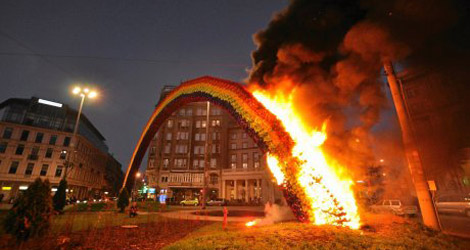
With all of this said, my aim was to experience modern European national pride. There were two main marches that day, and I wanted to attend both. The first one was the official government sanctioned “Presidential March” and the second was the self-organized nationalist  “Independence March.” They go different routes, but at one point they intersect at the Charles-de-Gaulle roundabout, where if it were not for the power of time, the two would collide with such force that the surrounding buildings would crumble to the ground from the aftershock.  The latter is historically known for its ruffianism, and last year they managed to burn down one of Warsaw’s most modern and friendly monuments, the rainbow at Zbawiciela Square. That is exactly where my bus dropped me off in the morning and from there I walked towards Saski Park where the start of the official march was taking place. Walking through the square I looked around to see swarms of SWAT team circling the pedestrian ring around the monument. It was undoubtedly the heaviest guarded place in Warsaw at the moment. Not even the President would have this many armed guards near him. The well-guarded rainbow is ostensibly associated with the LGBT movement, which is one reason the nationalist felt the need to burn it down. I curiously looked at the SWAT members in their complete American football style pads, and noticed that in the square about 80% (an educated guess) of the SWAT team were women, and I thought this was quite astonishing, but it was all a facade and I noticed as I left the square that in the alleys of the surrounding streets small squadrons of men-only SWAT were waiting to ambush any ultra-nationalist brazen enough to make a move in the square. Is this some sort of strategy? Did the women volunteer to be at the front? Were they the sympathetic face of the police? These are questions I most dearly wanted to ask. I felt no fear among the SWAT of Zbawiciela; there was no lingering energy getting ready to explode upon impact, but this was only morning and the nationalist march didn’t begin until mid-afternoon.

I made it to Saski Park and saw a swarm of Poles headed through the trees towards the open square of Plac Piłsudskiego, where Pope John Paul II triumphantly held Holy Mass 35 years ago on his first visit as Pope to communist Poland. At first, I tried not to meet other people’s eyes, because I felt disconnected and thought to myself that this is not my day, it is their (the Poles) day, and I am only an observer. But this soon gave way to the pageantry and festivity of the event, and I found myself admiring the amount of traditional Polish bread that was being sold around the giant fountain in the park. The stalls opened up around me, and there was not only bread, but also fried highlander cheese with cranberry sauce, and some sandwiches with pig fat and pickles on them. There were bright neon colored ropes of sour liquorice for the kids, and strings of the tasteless traditional Polish obwarzanki rings. The most intriguing for me were caramelized rice balls as big as a softball, so I chipped a few złoty in for one and munched on it on my way to the square.

Emerging from the pockmarked trees I noticed a giant ring of people surrounding the usually deserted square. There were some stands with official people sectioned off by a fence, and in the square were standing ten companies of celebratory soldiers. I milled around for a few minutes, and stood next to a pair of disgruntled homeless men whispering to each other. I imagined that they were mumbling some derogatory statements about the current government, and I wanted to ask them what it is that they could have against them, but I couldn’t speak their language. Soon I got bored and frustrated that I could not understand anything, and made my way back towards the carnivalesque booths in the park.

I asked for a sandwich with pickles and fat. “What is the name?” I asked.

“Marta,” she answered.

“No, no the name of the sandwich,” I responded, warily aware that I did not phrase my first question correctly in a more international dialect of English. She laughed, but did not tell me the name.

Then I was keen to try some of the cream colored fried cheese, so I headed to a booth and asked for one of the small football shaped portions that had cooked to an inviting brown around the edges.

“This cheese is from the mountains in Podhale,” the girl tells me. “Try it with the sauce. It is delicious.” She says this with a smiling face, and it truly was. It reminded me of the aromatic salty sulguni cheese of the Caucasus, but the cranberry sauce added a plump delicacy you could only find in a northern country.

I slowly made my way back to the square with the cheese in my hand and the half eaten caramelized rice ball in my backpack when suddenly a large boom startled me and I instinctively ducked as if we were under attack. Artillery fire was going off at consistent intervals, and that first one shook me so bad that I almost spit out the bite of cheese that was in my mouth. The sound was deafening, and the feeling was pulverizing, and I was struck with awe when I thought about how it was used in previous wars. I looked to the sky, and despite the initial fright I became enamored by of the ceremonial commemoration. Poland has a lot to be proud of today. Even though this Independence Day is based on Piłsudski’s restoration of an independent Poland between the two world wars, they really only gained political freedom and true sovereignty just 25 years ago, and since then it has turned around to become a driving force in EU politics, and its people and cities are now developing surprisingly fast. Warsaw is opening up a second metro line this winter, and Wrocław will be one of the European ‘Capitals of Culture’ in 2016.

I looked around in the square and thought that everyone looked elated and satisfied, and noticed families taking pictures with convivial signs that said ‘long live Poland.,’ and children were mounted on top of their fathers shoulders while he was jostling for a better look at the multi-colored soldiers. The people there looked family-oriented and soft. Their eyes were tightened with intelligence, and the sense that if they work hard, and work together Poland could be the great and tolerant melting pot of ideas that it once was in the distant past.  

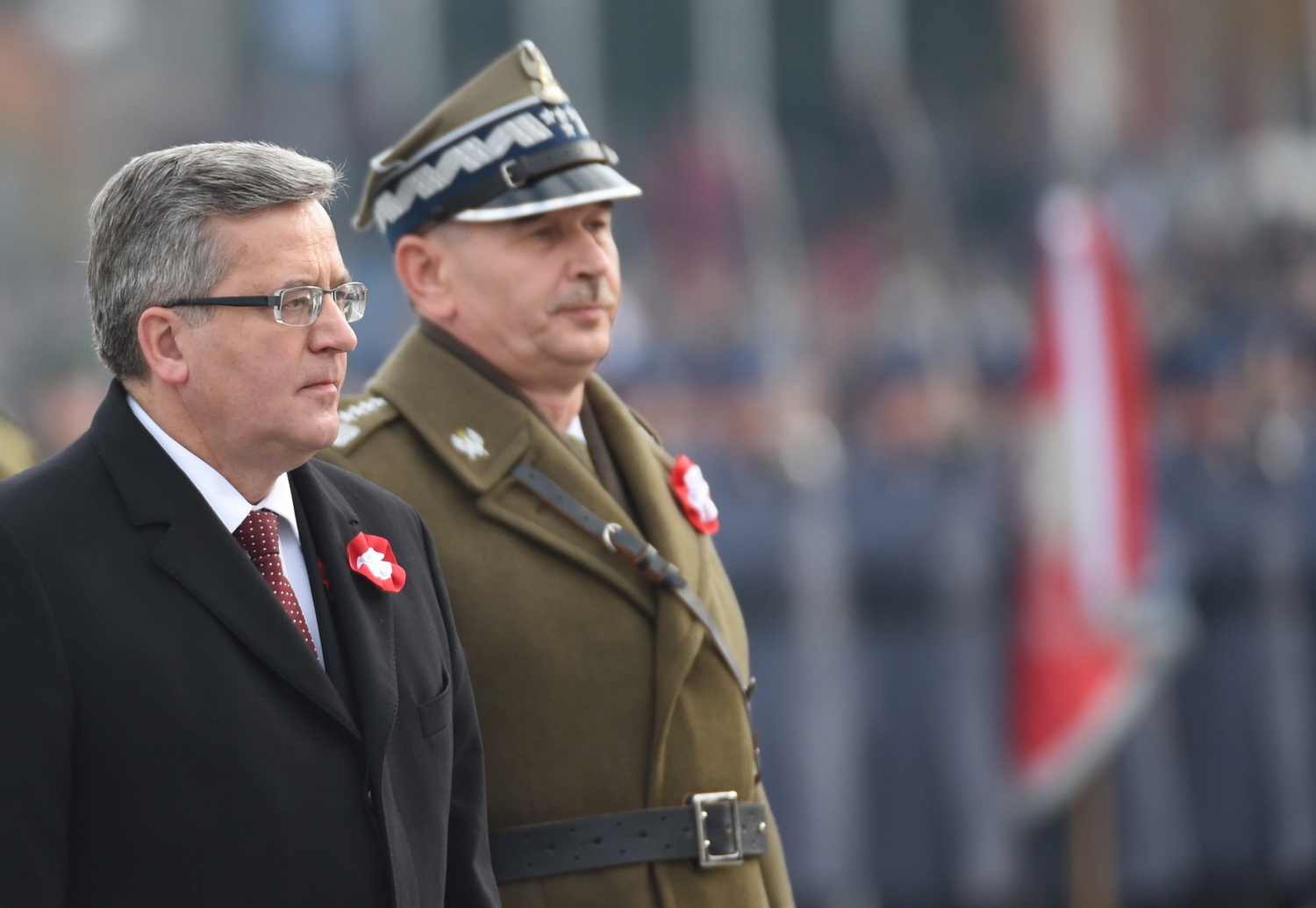
Just before the official march started, president Komorowski entered the square and walked along the line of soldiers. He symbolically inspected each company and gave his approval to each one with a nod of the head. As soon as he walked off, the march down Nowy Świat street towards Łazienki Park, and more specifically the statue of Piłsudski, began.


I followed them along the street, eventually coming to a good vantage point to watch the different sections go by. The parade was a historical procession of military units. Each era was represented, from WWI and on. There were young volunteers representing the Poles who fought on both sides of the First World War with the hope that they would gain independence, then, an actor playing Piłsudski rode by in a vintage Cadillac waving to everybody through the tinted windows. I watched as proud young adults dressed in shabby uniforms portrayed the brutally suppressed Polish Home Army. More and more came by, and finally the official companies that stood at the square brought an end to the marchers, but still I followed them, all the way to Piłsudski’s statue. I was most interested to see what would happen at the Russian embassy nearby, because last year the ultra-nationalist made an attempt to storm the premises, burning down some of the property. But I got lost in the back streets and couldn’t find my way to the embassy. It was getting close to the beginning of the nationalist march, and despite thinking that I might be satisfied with the cheerful and innocent official march, I decided it was time to head towards Dmowskiego roundabout where I expected to see far fewer people preparing for their menial riff-raff. 

Read part 2 here